If you've stumbled across the phrase "Maikoru hugging Palmon's uvula whisk FX" and found yourself completely puzzled, you're not alone. It sounds like someone accidentally typed a sentence in their sleep — but there's actually a growing creative community behind this quirky concept, and it's a lot of fun once you understand what it's asking you to do.
Whether you're a digital artist, an AI image generation enthusiast, or a Digimon fan who just wants to explore some out-of-the-box creativity, this guide walks you through everything you need to know — from understanding what this prompt means, to actually pulling it off step by step.
What Does "Maikoru Hugging Palmon's Uvula Whisk FX" Even Mean?
Let's break it down piece by piece, because the phrase is basically a stack of creative concepts piled on top of each other.
Maikoru refers to a whimsical, anime-inspired character that's gained traction in fan art communities for its expressive, playful design. The term is also used as shorthand for the MaikoruArts style — a creative aesthetic that blends soft character design with exaggerated, funny poses and close-up scenes.
Palmon is one of the most beloved characters from the Digimon franchise, first introduced in Digimon Adventure in 1999 by Toei Animation. She's the Digimon partner of Mimi Tachikawa — a cheerful, green, plant-like creature with a flower on her head, vine-like fingers, and a signature move called Poison Ivy. Over 25 years later, she remains one of Digimon's most recognisable faces, with a fanbase numbering in the millions worldwide.
The uvula is the small, fleshy, teardrop-shaped bit that hangs at the back of the throat. In fan art, including Digimon art, it shows up in exaggerated open-mouth expressions — think wide comedic faces, loud yelling poses, or playful close-up views of a character's expression. It sounds strange, but it's a well-established stylistic detail in anime-inspired work.
Whisk FX refers to Google's experimental AI image generation tool — part of Google Labs' ImageFX suite. Instead of typing lengthy prompts, Whisk lets you upload up to three reference images (a Subject, a Scene, and a Style), blends them using Google's Gemini model, and generates an output via Imagen 3. When people say "Whisk FX prompt," they mean using this tool to generate a specific AI artwork — in this case, something involving Maikoru and Palmon in an expressive, close-up scene.
So put it all together: Maikoru hugging Palmon's uvula whisk FX is a creative prompt used to generate AI-assisted fan art that shows the Maikoru character interacting playfully with Palmon, featuring a wide-open-mouth close-up with the uvula visible, rendered through Whisk or ImageFX with animated-style effects.
Why Is This Prompt Popular?
Honestly? Because it's the perfect storm of internet creativity.
Digimon fan searches have risen significantly in recent years, driven by anniversary releases, reboots, and nostalgia waves. Meanwhile, AI art tools like Whisk have opened up image generation to people who have no traditional drawing experience at all. Fan communities thrive on inventing oddly specific, niche prompts — and this one checks all the boxes: it's funny, visually interesting, technically challenging, and attached to a beloved franchise.
The MaikoruArts creative style is particularly popular because of its warmth and humor. It encourages artists to capture affection, silliness, and genuine character personality rather than just static poses. A hug from Maikoru landing on Palmon's uvula? That's absurdist fan creativity at its finest — and it works.
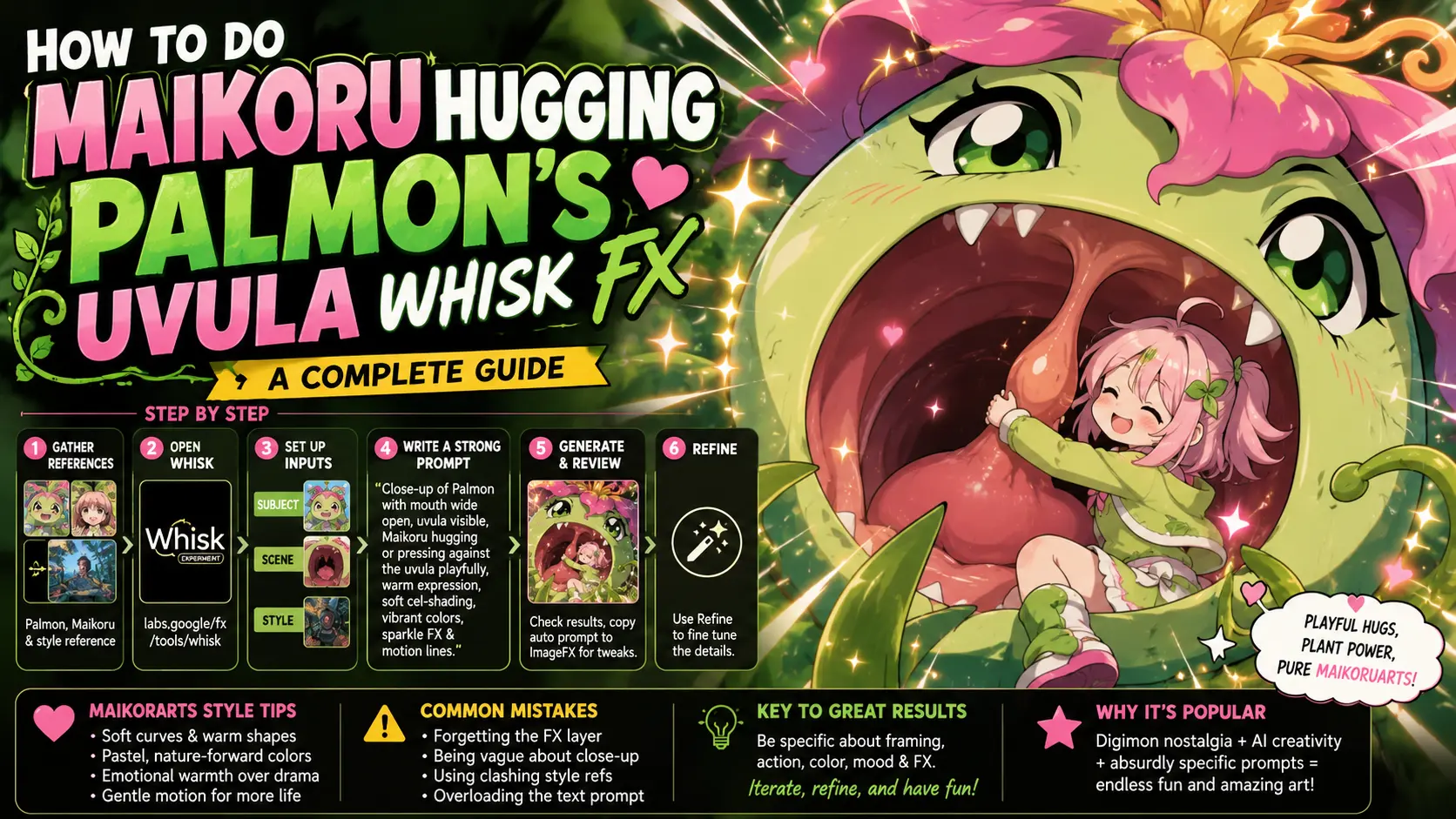
How to Do the Maikoru Hugging Palmon's Uvula Whisk FX Prompt — Step by Step
Step 1: Gather Your Reference Materials
Before you open any software, spend five minutes collecting what you need:
- A clear image of Palmon (official Digimon art works best — look for images where her face is expressive, front-facing, or open-mouthed)
- A Maikoru character reference or any anime-style character art that fits the aesthetic you want
- A style reference — a cel-shaded Toei Animation screenshot or Digimon anime art works beautifully here
Having these ready saves a lot of back-and-forth once you're inside the tool.
Step 2: Open Google Whisk
Go to labs.google/fx/tools/whisk. You'll need a Google account and will have to complete age verification (18+) on your first visit. Once inside, you'll see three image upload boxes: Subject, Scene, and Style, plus a text input field below them.
Step 3: Set Up Your Three Input Slots
Here's how to assign your references:
- Subject → Upload your Palmon image. This tells Whisk who the main character is.
- Scene → Use an open-mouth close-up or a "mouth interior" style image. Some artists use anime reaction face references here. A jungle or leafy background works too, keeping Palmon's nature theme intact.
- Style → Upload your cel-shading or Digimon anime reference. This keeps the final output feeling faithful to the source material rather than looking like generic AI art.
Step 4: Write a Strong Text Prompt
This is where most people either nail it or lose the plot. The text box below the images is your chance to guide the specific details Whisk might miss. Be precise. Vague prompts give vague results.
A strong prompt might look something like this:
Close-up of Palmon with mouth wide open, uvula clearly visible, Maikoru character hugging or pressing against the uvula playfully, warm expression, soft anime cel-shading, vibrant greens and pinks, Digimon Adventure art style, sparkle FX and motion lines
Notice it covers: the framing (close-up), the specific detail (uvula), the action (hugging/pressing), the mood (warm, playful), the colour palette, and the effects (sparkle FX, motion lines). Every element earns its place.
Step 5: Generate and Review
Hit generate and let Whisk do its thing. The output won't always be perfect on the first try — and that's completely normal. Even experienced prompt engineers iterate multiple times. If the result is close but not quite right, click any output image to reveal the auto-generated text prompt Whisk created behind the scenes. Copy that, paste it into ImageFX (also in Google Labs), and manually adjust the language around the uvula detail, lighting, and expression until you get what you're after.
Step 6: Refine With the Refine Button
Whisk has a Refine option when you hover over any output image. Use it for small tweaks — adjusting brightness, emphasis on certain features, or softening the overall style — without having to regenerate from scratch. This saves a lot of time when you're 80% of the way there.
Tips for the MaikoruArts Style Specifically
If you want to capture the MaikoruArts aesthetic in your prompt rather than a generic anime look, keep these principles in mind:
- Soft curves everywhere. The MaikoruArts style leans into rounded, warm shapes. Avoid sharp or aggressive linework in your style references.
- Pastel and nature-forward colours. Think gentle greens, soft pinks, warm yellows. Palmon's natural palette already leans this way, so lean into it.
- Emotional warmth over drama. The hug isn't aggressive — it's affectionate and playful. Prompt for warmth, not intensity.
- Secondary motion details. A slight sway or bouncing quality in the character's pose adds life. If you're animating, even a subtle looping motion makes a massive difference to how the piece reads emotionally.
Common Mistakes to Avoid
A few things trip people up with this prompt:
Forgetting the FX layer. The "FX" part is easy to overlook but it's what gives the piece energy. Always add effects — sparkles, motion blur, glow, or swirling lines — as a final layer, not an afterthought.
Being too vague about the close-up framing. If you don't explicitly describe an open-mouth close-up, Whisk will default to a full-body or mid-shot pose. Be specific about framing from the start.
Using style references that clash. Mixing a hyper-realistic style image with a cel-shaded subject leads to muddy, inconsistent outputs. Keep your Subject, Scene, and Style references tonally consistent.
Overloading the text prompt. More words do not equal better results. Prompts are not essays. Stick to the most specific, meaningful details and let the images do the rest of the heavy lifting.
Final Thoughts
The Maikoru hugging Palmon's uvula whisk FX prompt is a brilliant example of what happens when fan creativity, AI tools, and internet culture collide. It sounds bizarre until you understand the logic underneath — and once you do, it becomes a genuinely satisfying creative challenge.
The process itself teaches you something valuable: specificity is a skill. The more clearly you can articulate exactly what you want — the framing, the mood, the colours, the character interaction — the better your results will be, not just in AI art but in creative work generally.
So open up Whisk, grab your Palmon reference, and give it a go. Your first output probably won't be perfect. That's fine. Iterate, refine, and have fun with it. The fan community is out there, and they're always excited to see what someone comes up with next.