If you're staring at your kitchen sink wondering exactly which model you own, you're not alone. Sink model numbers like SDZIC462/500 are easy to lose track of — yet you need them the moment you want a matching replacement, a spare part, or the right accessory. The good news: that code is almost always hiding somewhere close by, and this guide walks you through every place to look.
Below, we'll cover exactly how to find your SDZIC462/500 sink model number step by step, how to read what the number is telling you, and how it connects to the wider world of residential kitchen sinks — from drop-in and undermount styles to composite materials, popular brands, and standard sizing. By the end, you'll be able to identify your sink with confidence and shop for the perfect match.
What the SDZIC462/500 Sink Model Number Actually Means
A sink model number is a manufacturer's unique fingerprint for one specific product. The SDZIC462/500 code identifies a particular sink design — its shape, bowl layout, mounting style, and size — so that everyone from the factory to the warehouse to the customer is talking about the exact same item. No two distinct models share the same number.
Think of it like a car's make and model combined with its trim level. "A kitchen sink" is far too vague to order a part for. But "SDZIC462/500" points to one precise product with known dimensions, a known bowl configuration, and known accessories that fit it. That's why, when you contact a seller or search online, the model number gets you an exact answer instead of a guess.
Codes in this style usually pack several clues into a short string. The letters often hint at a product family or material, while the numbers frequently encode size or a sequence within that range. We'll decode the SDZIC462/500 format in more detail further down, but the key takeaway is simple: this number is the single most reliable way to identify your sink.
Why Your Sink's Model Number Matters More Than You Think
It's tempting to ignore a model number until something goes wrong — but knowing it ahead of time saves real money and frustration. Here's where it becomes essential:
- Buying a replacement that fits the existing hole. Countertop cut-outs are unforgiving. If your old sink was an SDZIC462/500 and you want a like-for-like swap, the model number guarantees the new one drops into the same opening without re-cutting your worktop.
- Ordering the correct accessories. Drainboards, basket strainers, bottom grids, cutting boards, and waste kits are often designed for a specific bowl shape and size. The model number tells the seller exactly which accessory version you need.
- Warranty and support claims. Manufacturers ask for the model number first. Without it, a warranty conversation stalls before it starts.
- Comparing prices honestly. When you search the model number, you can compare the same sink across multiple retailers instead of comparing two sinks that merely look similar in photos.
Quick tip: Once you find your SDZIC462/500 number, snap a photo of it on your phone and save it in a "home info" note alongside your appliance models. Future-you will be grateful when a part finally needs replacing.
Where to Find the SDZIC462/500 Model Number (Step by Step)
Manufacturers print the model number in a handful of predictable spots. Work through these in order — most people find it within the first two or three checks.
1. Underneath the sink and around the basin
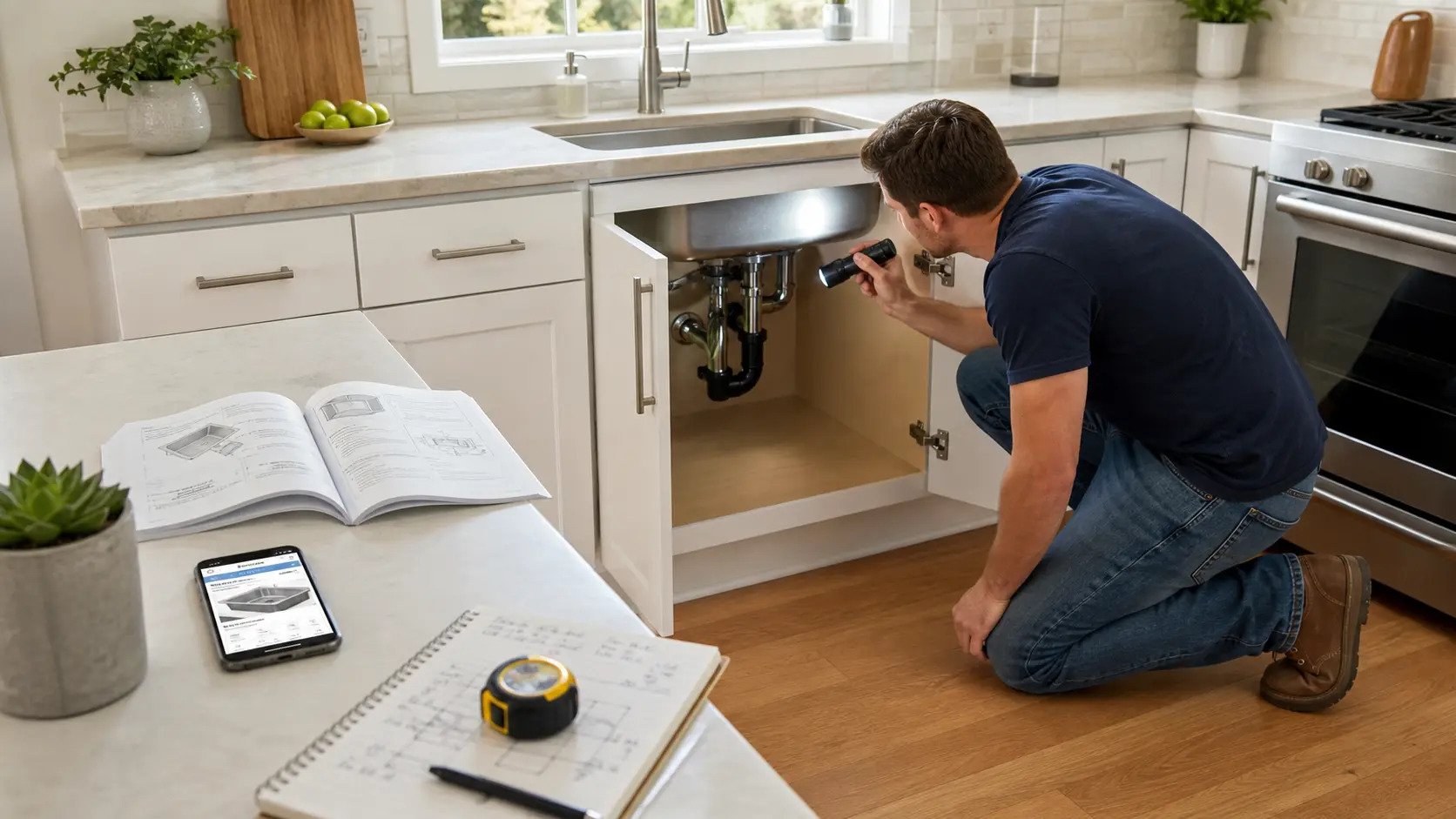
Open the cabinet beneath your sink, grab a flashlight, and look at the underside of the bowl and the inside walls of the basin. Manufacturers commonly stamp, etch, or sticker the model number on the underside, near the drain hole, or along the back rim where it stays hidden once installed. On a single bowl sink the marking is usually centered under the basin; on a double basin layout, check under both bowls and the divider.
2. On the original box or packaging
If you kept the carton, the model number is printed on the shipping label and the spec panel, almost always near a barcode. Packaging often lists the full code (like SDZIC462/500) plus the bowl count, material, and finish — a goldmine of identifying detail in one place.
3. On your purchase receipt or invoice
Dig out the original receipt, order confirmation email, or invoice. Retailers list the model number as the line-item SKU. If you bought online, search your email inbox for the store name or the word "sink" to surface the order quickly.
4. On the manufacturer's label or rating plate
Many sinks carry a small adhesive label or a laser-etched plate showing the brand, model number, and sometimes a production date or batch code. Wipe the area clean first — grease and limescale love to obscure exactly the text you need.
5. In your online account or order history
If you purchased through a marketplace or a brand's own website, log in and open your past orders. The product page you bought from will still show the model number, even years later, and often links straight to the matching replacement.
Still can't find it? Photograph the whole sink from above plus a close-up of any visible markings, then send the images to the retailer or manufacturer's support team. They can frequently identify a model — even an SDZIC462/500 — from clear photos of the bowl shape, corner radius, and drain placement.
How to Read and Decode the SDZIC462/500 Code
Once you've located the number, it helps to understand what it's telling you. While every brand has its own system, codes like SDZIC462/500 typically break into two meaningful parts.
The letter prefix — "SDZIC" — usually flags a product family, a material group, or a series name the manufacturer uses internally. The numeric portion — "462/500" — commonly encodes size or model sequence. A slash often separates two related measurements (for example, an overall length and a bowl width in millimetres) or distinguishes variants within the same line.
You don't need to crack the code perfectly to use it. The string as a whole is what matters when ordering. But recognising the pattern helps you spot close relatives: if you see an SDZIC sink with different trailing numbers, it likely belongs to the same family with a different size or bowl layout. That's handy when the exact model is discontinued and you're hunting for the nearest equivalent.
| Part of code | Often represents |
|---|---|
| SDZIC | Product family / material series |
| 462 | Size or variant code |
| /500 | Secondary measurement or sub-version |
Common Kitchen Sink Types (So You Can Match Yours)
Identifying your model is easier when you know which broad category it falls into. Most residential kitchen sinks fit one of these mounting styles, and the SDZIC462/500 will belong to one of them too.
Drop-in (top-mount) sinks
A drop in kitchen sink sits in a hole cut into the countertop, with a visible rim resting on the surface to hold it in place. This is the most common and most forgiving style to install, since the rim hides small imperfections in the cut-out. If your sink has a lip sitting on top of the counter, you've got a drop in sink.
Undermount sinks
An undermount sink is fixed beneath the countertop so the counter edge forms the rim of the opening. The result is a sleek, seamless look that's easy to wipe crumbs straight into. A white undermount kitchen sink is especially popular in modern kitchens, and sizes like a 30" white undermount kitchen sink are a go-to for standard cabinets. Brands such as Blanco are well known for their undermount range.
Apron-front and farmhouse sinks
A farmhouse (or apron) sink has an exposed front panel that's visible at the edge of the cabinet. It offers a deep, roomy basin and a charming, timeless look. Most are undermount-style, but a farmhouse sink overmount version exists too, sitting on top of the counter for simpler retrofits. We'll cover apron sink dimensions in the sizing section.
Single bowl vs. double basin
A single bowl sink gives you one large, uninterrupted basin — great for washing big pots and trays. White single bowl kitchen sinks are a clean, popular choice. A double basin splits the space into two, letting you wash on one side and rinse or drain on the other; white double basin kitchen sinks suit busy family kitchens. Knowing whether your SDZIC462/500 is a single or double bowl narrows the search immediately.
Sink Materials: What Yours Is Likely Made Of
Material affects look, durability, weight, and price — and it can be a clue baked into the model code. Here are the materials you'll meet most often when shopping residential kitchen sinks.
- Granite / composite. Made from crushed stone bound in resin, composite sinks are tough, scratch-resistant, and quiet under running water. A gray composite sink is a hugely popular neutral, and pegasus composite sinks are a familiar name in this category. Composite handles heat and everyday knocks well.
- Stainless steel. Lightweight, affordable, and endlessly practical. Stainless suits almost any kitchen and resists stains, though it can show water spots and fine scratches.
- Fireclay & ceramic. Classic, glossy, and very hard-wearing. These are common in farmhouse styles and deliver that crisp, bright finish people love in a white deep sink.
- Cast iron with enamel. Heavy and traditional, with a smooth coated surface available in many colours — including the warm tones you'll find when browsing brown kitchen sinks for sale.
Colour is part of the decision too. White remains the all-time favourite for its clean, timeless appeal, but gray composite, charcoal, and warm browns are rising fast for homeowners who want something a little different while keeping the look subtle and cohesive.
Popular Sink Brands and How Their Model Codes Work
Understanding how leading brands number their products helps you place an SDZIC462/500 in context and find true equivalents.
Blanco
Blanco kitchen sinks are known for precision engineering and a clean European aesthetic. The brand's Blanco Precis sink line, for example, uses composite construction in a range of bowl sizes, and a Blanco undermount sink is a frequent choice for seamless modern counters. When you browse Blanco sinks, you'll notice the model names typically combine a series name with a size descriptor — much like the structure we decoded earlier.
Pegasus
Pegasus sinks are a popular value-focused option, especially their composite range. Pegasus composite sinks offer the durability of stone composite at an approachable price, making them a common find in everyday residential kitchens. Their model codes likewise encode bowl style and size.
The lesson across brands is consistent: a model code is never random. Whether it's a Blanco, a Pegasus, or your SDZIC462/500, the string ties back to a specific bowl configuration, material, and size. Matching that string is what guarantees you get the right product.
Sink Dimensions and Sizing Guide
Sizing is where a model number earns its keep. Even sinks that look identical can differ by an inch or two — enough to ruin a countertop fit. Use this reference for the most common residential sizes, then confirm against your specific SDZIC462/500 measurements.
| Sink style | Typical width | Typical depth (front-to-back) | Typical bowl depth |
|---|---|---|---|
| Single bowl (standard) | 24–30 in | 18–22 in | 8–10 in |
| 30" undermount | 30 in | 18–19 in | 9–10 in |
| Double basin | 30–36 in | 20–22 in | 8–10 in |
| Farmhouse / apron | 30–36 in | 18–21 in | 9–10 in |
Farm sink dimensions tend to run larger and deeper than standard drop-ins, which is part of their appeal — they swallow big roasting trays with ease. When planning, remember that a farmhouse sink needs a specially built cabinet to support its weight and its exposed front, so apron sink dimensions should be checked against both the cabinet width and the apron height.
Always measure three things before buying: the countertop cut-out (the hole), the cabinet's internal width (the box the sink drops into), and the bowl depth (how deep the basin goes). Matching all three to your model number's published specs is the surest route to a clean, leak-free fit.
Rule of thumb: Your sink cabinet should be at least 3 inches wider than the sink itself. For a 30-inch sink, plan on a 33-inch base cabinet.
Matching a Replacement or Accessory by Model Number
Once you've confirmed your SDZIC462/500 number, replacing the sink or buying accessories becomes straightforward. Follow this short sequence:
- Search the exact model number first. Type "SDZIC462/500" into your retailer's search bar and into a general web search. This surfaces the precise product and any official accessories.
- If it's discontinued, find the successor. Manufacturers often replace a model with an updated version sharing similar dimensions. Look for sinks in the same family (same letter prefix) with matching bowl size.
- Match by dimensions as a backup. If the model is truly gone, measure your cut-out and shop by size — a 30-inch single bowl, for example — choosing the closest fit in your preferred material and colour.
- Confirm the drain position. Centre-drain vs. rear-drain affects under-cabinet plumbing and storage. Match this to avoid surprises during installation.
For accessories, the model number lets sellers point you to the exact bottom grid, basket strainer, or cutting board sized for your bowl. Generic accessories sometimes work, but a model-matched part fits snugly and looks built-in.
Smart Tips for Buying Residential Kitchen Sinks
Whether you're replacing the SDZIC462/500 with the same model or upgrading to something new, keep these practical pointers in mind:
- Match the sink to how you cook. Heavy pot users love a deep single bowl sink; multitaskers prefer a double basin for simultaneous washing and rinsing.
- Pick a finish you'll enjoy daily. A white deep sink looks crisp but shows stains sooner; a gray composite sink hides marks and water spots beautifully while staying subtle.
- Mind the mounting style. Undermount gives a seamless, easy-clean edge; a drop in kitchen sink is simpler and cheaper to install. Choose based on your counter material and budget.
- Check warranty and availability of parts. Established brands like Blanco and Pegasus make it easier to source matching accessories years down the line.
- Buy the right size cabinet first. The sink dictates the cabinet, especially for farmhouse and apron styles that need reinforced support.
Above all, keep your model number handy throughout the process. It removes guesswork, prevents costly mis-orders, and turns an intimidating purchase into a confident one.
Frequently Asked Questions
Where is the SDZIC462/500 model number usually printed?
Most often on the underside of the basin, on the original box or packaging, on your purchase receipt or invoice, or on a small manufacturer's label near the drain. Checking the cabinet underneath the sink with a flashlight is the fastest first step.
What does the SDZIC462/500 code actually tell me?
The letters typically indicate the product family or material series, while the numbers usually encode size or a variant within that line. As a whole, the code identifies one exact sink — its bowl layout, mounting style, and dimensions.
Can I find my sink model from a photo if the label is gone?
Often, yes. Clear photos of the bowl shape, corner radius, and drain position — sent to the retailer or manufacturer — can be enough for support staff to identify the model, even without a visible number.
What if the SDZIC462/500 is discontinued?
Look for the manufacturer's successor model in the same family, or shop by exact dimensions. Match the cut-out size, bowl depth, and drain position to get the closest equivalent that drops into your existing countertop.
How do I make sure a new sink fits my counter?
Measure three things: the countertop cut-out, the internal width of the base cabinet, and the bowl depth. Compare all three against the model's published specifications before ordering.
Are composite sinks better than stainless steel?
It depends on your priorities. Composite (like a gray composite sink) is quiet, scratch-resistant, and hides marks well. Stainless is lighter, cheaper, and very practical. Both are excellent residential choices.
Final Thoughts
Finding your SDZIC462/500 sink model number isn't complicated once you know where to look — under the basin, on the box, on your receipt, or on a tucked-away label. That short string is the key to ordering the right replacement, the perfect accessory, and the correct warranty support, with none of the guesswork that leads to costly mistakes.
Take a few minutes today to locate the number and save a photo of it. Whether you stick with your current model or move on to a fresh white undermount kitchen sink, a roomy farmhouse basin, or a durable composite design from a trusted brand, you'll be shopping from a place of confidence — and your next sink will fit, function, and look exactly the way you want it to.