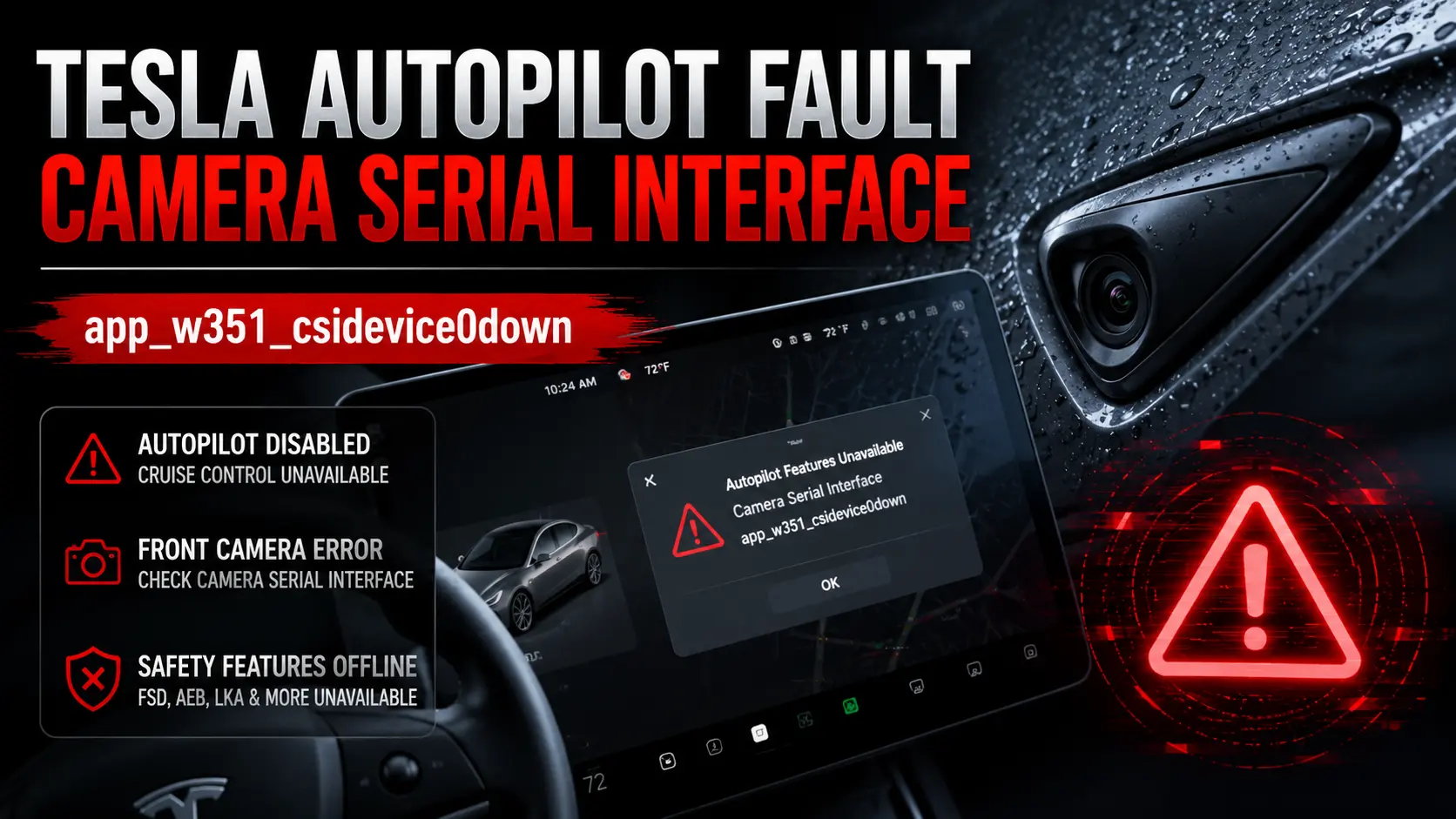
The app_w351_csidevice0down error code is one of Tesla's most disruptive Autopilot alerts — it cuts off Autopilot, FSD, and active safety features in one shot, with no obvious warning to the driver. This definitive guide breaks down what the app_w351_csidevice0down error code means at a hardware level, why it happens, and exactly how to fix it — from a 10-second reboot to a Tesla Service Center visit.
What Is the app_w351_csidevice0down Error Code?
The app_w351_csidevice0down error code is a Tesla Autopilot subsystem fault logged in your vehicle's service alert panel. It signals that Camera Serial Interface (CSI) Device 0 — the primary camera node in Tesla's multi-camera vision stack — has dropped its hardware connection to the Autopilot processing unit (HW3 or HW4).
Because Tesla's safety model requires every camera to be online before enabling any driver-assistance feature, a single CSI Device 0 failure triggers a cascade: Autopilot suspends, FSD disengages, Traffic-Aware Cruise Control locks out. The car is still fully drivable in manual mode — but every advanced feature that depends on forward camera data goes dark until the app_w351_csidevice0down fault is resolved.
Unlike the broader APP_w305 ("camera stream exit") alert, the app_w351_csidevice0down fault is a hardware-channel fault — meaning the issue is deeper than a software restart can always reach. That said, roughly 70% of reported cases are resolved by software resets alone, so always start there before assuming physical damage.
Decoding the app_w351_csidevice0down Error String Segment by Segment
Tesla's fault codes follow a rigid naming convention. Understanding each component of app_w351_csidevice0down tells you exactly which system is failing and how severely:
The "W" (Warning) classification means app_w351_csidevice0down disables features but does not trigger a vehicle shutdown or require an immediate tow. The integer 351 uniquely identifies this as a CSI-channel fault — distinct from APP_w305 (general stream failure), APP_w269 (right-pillar camera), or APP_w182 (interior camera). If you see companion codes alongside app_w351_csidevice0down, it typically points to a wiring harness issue rather than a single camera failure.
6 Root Causes of the app_w351_csidevice0down CSI Camera Fault
Pinpointing the cause before you attempt a fix saves time and prevents unnecessary service costs. The app_w351_csidevice0down error code is triggered by six distinct failure scenarios, ranging from a 10-second software fix to a camera module replacement:
app_w351_csidevice0down.app_w351_csidevice0down persists, request a full Toolbox 3 diagnostic to rule out a failing FSD computer.Symptoms: What Breaks When the app_w351_csidevice0down Error Code Fires
The app_w351_csidevice0down error code rarely arrives alone. It tends to produce a recognizable cluster of failures across the dashboard, Autopilot system, and camera feeds. Identifying this pattern early helps you distinguish this specific CSI fault from other Tesla camera errors:
- Autopilot fully disabled — the Autopilot icon grays out and cannot be engaged regardless of road conditions
- "Cameras Unavailable" touchscreen alert — displayed prominently on the main center display
- FSD and Traffic-Aware Cruise Control locked out — neither can be activated mid-drive or at startup
- Forward camera visualization blank — the front camera feed shows no image on the visualization screen
- Dashcam / Sentry Mode unreliable — recording may stop or fail to initialize due to the missing camera feed
- Companion fault codes in service alerts — APP_w305, APP_w182, or APP_w269 alongside
app_w351_csidevice0down - Error persists across multiple drive cycles — unlike fog or condensation errors that clear with temperature, this fault survives restarts
10-Step Fix Guide for the app_w351_csidevice0down Error Code
The steps below are sequenced by likelihood of success — the fastest, highest-success-rate fixes come first. Most owners resolve the app_w351_csidevice0down error code within the first three steps. Only proceed further if earlier steps fail to clear the fault after a full drive cycle.
With the car in Park, hold both steering wheel scroll buttons simultaneously for 10 seconds until the screen goes black. Wait the full 90 seconds for the Tesla logo to reappear. This resets the entire UI stack and clears transient CSI bus faults responsible for many app_w351_csidevice0down events. Check service alerts after restart.
Go to Controls > Safety > Power Off. Do not open a door or touch the brake for a full 5 minutes. This kills the 12V system and forces a clean hardware-level CSI controller restart — more thorough than the scroll wheel reboot and the second most effective fix for app_w351_csidevice0down errors caused by firmware issues.
Navigate to Controls > Service > Camera Calibration > Clear Calibration and confirm. This forces the Autopilot system to reinitialize all camera feeds from scratch, often clearing a stale app_w351_csidevice0down state left over after a firmware update or windshield replacement. Drive 20–25 miles on clearly marked roads at mixed speeds for calibration to complete.
Go to Controls > Software > Software Update and install any pending release. Tesla has patched several camera driver bugs — including CSI initialization failures that trigger the app_w351_csidevice0down error code — in over-the-air updates. This is a zero-effort fix that frequently resolves the fault on the next startup after installing.
Enable Service Mode, then navigate to Service > Driver Assist > Cameras > Reset DAS. After reset, check the camera diagram — all nodes should show green. Any red indicator after the DAS reset pinpoints exactly which camera is responsible for the app_w351_csidevice0down fault, narrowing your physical inspection.
Unplug every USB drive, charging cable, and accessory — including the glove box USB port used for Sentry Mode. USB bus conflicts during initialization have been confirmed to produce app_w351_csidevice0down errors at boot. Remove everything, do a full power cycle (Step 2), then check if the Tesla camera serial interface fault clears before reconnecting anything.
Heavy soiling on the forward camera lens behind the rearview mirror can degrade signal quality enough for the CSI bus to log a Device 0 Down fault. Clean gently with a lint-free microfiber cloth and 70% isopropyl alcohol. Pay attention to the edges of the camera housing where grime collects. Never use abrasive cloths or window cleaners containing ammonia.
Locate the camera connector at the rearview mirror mount. After windshield replacements, this connector is frequently left partially unseated — the single most common preventable cause of the app_w351_csidevice0down error code. Gently press the connector firmly until it clicks. Do not force it or bend the retention clip. Perform a power cycle after re-seating to test.
If Phases 1 and 2 fail to clear the app_w351_csidevice0down error code, book a service appointment via the Tesla app: Schedule Service > Autopilot > Camera Issue. Include a note that the fault is app_w351_csidevice0down and list any companion codes. Tesla technicians use Toolbox 3 to run a full CSI bus diagnostic, confirming whether the fault is in the camera, harness, or Autopilot computer.
Hardware-confirmed failures require either a forward camera replacement or — in rare cases — an HW3/HW4 Autopilot computer swap. Both procedures require Tesla's proprietary Service Mode and Toolbox 3 firmware flash to correctly initialize the new hardware. Camera replacement runs $400–$900; Autopilot computer replacement is $1,000–$3,000+, but may be fully covered under warranty if no physical damage is involved.
DIY vs. Tesla Service Center: Full Cost & Time Breakdown
Before committing to a service appointment for the app_w351_csidevice0down error code, reference this table to understand what is DIY-safe and where the costs escalate:
| Fix Method | Who Does It | Est. Time | Est. Cost | Success Rate |
|---|---|---|---|---|
| Soft reboot / scroll wheel reset | DIY | 2 min | Free | ~35% |
| Full 12V power cycle | DIY | 10 min | Free | ~50% |
| Clear calibration + re-drive | DIY | 20–25 mi | Free | ~60% |
| OTA firmware update | DIY | 30–60 min | Free | ~55% |
| Harness connector re-seat | DIY (careful) | 15 min | Free | ~70% (post-windshield) |
| Full Toolbox 3 DAS diagnostic | Service Center | 1–2 hrs | $0–$150 | Diagnosis only |
| Forward camera replacement | Service Center | 2–4 hrs | $400–$900+ | ~98% |
| HW3 / HW4 Autopilot computer swap | Service Center | 4–8 hrs | $1,000–$3,000+ | ~99% |
Account > Vehicle > Warranty before authorizing any paid repair.How to Prevent the app_w351_csidevice0down Error Code from Returning
Use OEM-Spec Glass for Every Windshield Replacement
Aftermarket windshield glass with incorrect acoustic damping properties interferes with the forward camera's integrated mount bracket — the leading preventable trigger of the app_w351_csidevice0down error code. When a windshield must be replaced, always use Tesla-approved OEM-spec glass, confirm the installer reseats the camera harness, and schedule camera calibration immediately afterward via Controls > Service > Camera Calibration.
Keep Tesla Firmware Updated to Avoid CSI Driver Bugs
Numerous owners have experienced the app_w351_csidevice0down error code following a specific firmware version, only for it to clear automatically after Tesla pushed a patch. Enable automatic updates under Controls > Software > Software Update Preference > Advanced to receive CSI driver fixes as soon as they ship, before the bug can activate on your vehicle.
Protect the Forward Camera from Thermal Extremes
Parking indoors or in a covered garage during extreme temperatures reduces thermal cycling stress on the CSI bus connectors. In winter, avoid directing hot high-pressure water at the camera mount during car washes — rapid thermal shock degrades the connector contacts over time and contributes to intermittent app_w351_csidevice0down faults.
Monitor Tesla Service Alerts for Early Warning Signs
The Tesla app's service alert history often logs precursor faults — APP_w182, APP_w305, APP_w269 — weeks before the app_w351_csidevice0down error code fully manifests and disables Autopilot. Check service alerts after every drive and address any camera-related warnings proactively rather than waiting for a full lockout on the highway.
Frequently Asked Questions About the app_w351_csidevice0down Error Code
Controls > Service > Camera Calibration > Clear Calibration and drive 20–25 miles on marked roads. If the fault persists, inspect the harness connector above the mirror mount.app_w351_csidevice0down fault.Final Verdict on the app_w351_csidevice0down Error Code
The app_w351_csidevice0down error code sounds more severe than it usually is. Yes, it kills Autopilot instantly — but approximately 70% of cases trace back to software-level causes that a 10-second reboot or calibration reset can fully resolve. The remaining cases almost always point to a loose harness connector (common post-windshield replacement) or a failed camera module, both of which are well-understood repairs with clear cost estimates.
The right approach: start at Phase 1, work methodically, and only escalate when the prior step definitively fails. Check your Tesla warranty before agreeing to any paid repair, and always address companion fault codes (APP_w305, APP_w269) at the same time — overlapping camera faults often share a single root cause. Bookmark this guide, keep firmware updated, and use certified glass for any windshield work. Those habits alone eliminate the three most common triggers of the app_w351_csidevice0down Tesla camera fault.