Stop guessing. This complete guide answers the exact question — with a free zip code to zip code delivery time estimator, USPS service breakdowns, real delivery timelines, and every factor that can speed up or slow down your mail.
The Real Answer to "How Long Will Mail Take From Zip Code to Zip Code?"
You've got something important to send. Maybe it's a birthday card, a legal document, a check, or a return package. You drop it in the mailbox — and then comes the anxious thought: when will this actually arrive? That's exactly why people search for a how long will mail take from zip code to zip code calculator — guessing just doesn't cut it when timing matters.
The frustrating truth is that there's no single answer. The mail delivery time from zip code to zip code depends on three things above everything else: which USPS service you used, how far the destination is from the origin, and whether anything external — weather, holidays, volume spikes — got in the way. What there is, though, is a reliable way to estimate it.
USPS handles roughly 425 million pieces of mail every day. Within that system, your envelope gets sorted, routed through sectional center facilities (SCFs), and handed off to local carriers for final delivery. Understanding even the basics of how that pipeline works tells you a lot about why some mail arrives in a day and some takes five.
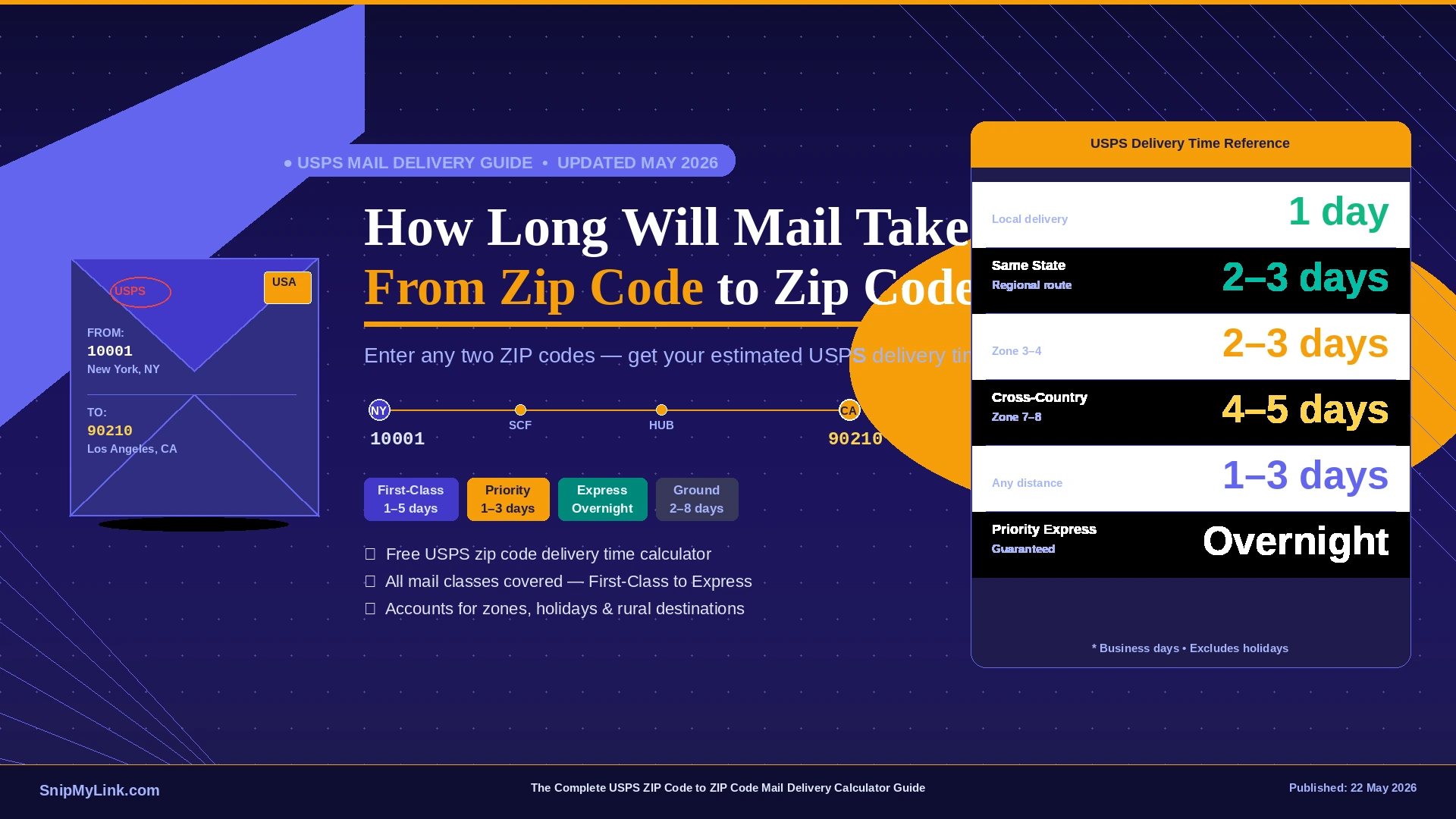
Here's the short version before we go deep: mail delivery time from zip code to zip code for local destinations is usually the next business day. Regional routes — same state or nearby — land in two to three days. Cross-country mail, from an East Coast zip code to a West Coast one, takes three to five business days via First-Class. Priority Mail compresses every one of those windows by a day or two. Express Mail guarantees overnight in most cases.
The official how long will mail take from zip code to zip code calculator from USPS — called Service Commitments — is free and takes under 30 seconds. But knowing why the estimate comes out the way it does — and what can shift it by a day or two — is exactly what this guide covers.
Free Zip Code to Zip Code Mail Delivery Calculator
Wondering how long will mail take from zip code to zip code? Enter your origin and destination ZIPs below. This mail delivery time calculator uses USPS zone logic and official service windows to give you a real zip code to zip code delivery time estimate for each mail class — no redirects, no account.
Mail Delivery Time Calculator
Enter both ZIP codes to estimate delivery times across all USPS mail classes.
The estimates above are based on the USPS zone system — the way USPS groups ZIPs by geographic proximity to origin processing facilities. Zone 1 means local shipping; Zone 8 means crossing the entire country. This zip code to zip code mail transit time logic is the same one USPS uses internally.
If you need the exact guaranteed date — with documentation for legal or business use — the official USPS Service Commitments tool at usps.com is your source. The calculator above gives you a reliable estimate for standard conditions, which covers most everyday shipping decisions.
USPS Mail Classes — The Biggest Variable in Any Zip Code Delivery Time
The single biggest variable in any how long will mail take from zip code to zip code calculator result isn't distance — it's the mail class you select. USPS offers four main services for standard shipping, and choosing the wrong one is the most common reason people are blindsided by slow delivery.
First-Class Mail — 1 to 5 business days
The default for letters, postcards, bills, greeting cards, and small packages up to 13 oz. Lowest cost USPS offers.
- Same city/local: 1–2 business days
- Same state/regional: 2–3 business days
- Cross-country: 3–5 business days
- Tracking: Included for packages; not for plain letters
- Weekend delivery: No — Monday through Friday only
Note: USPS doesn't guarantee First-Class delivery time — the 1–5 day window is a service standard, not a commitment.
Priority Mail — 1 to 3 business days
The reliable middle ground. Faster than First-Class, cheaper than Express. What most businesses and e-commerce sellers use as their standard.
- Local: 1–2 business days
- Regional: 1–2 business days
- National: 2–3 business days
- Up to 70 lbs, tracking included, Saturday delivery included
- Insurance: Up to $100 included
On-time rate for Priority Mail consistently runs above 94%.
Priority Mail Express — Overnight to 2 days
USPS's fastest and only guaranteed delivery service. Comes with a money-back guarantee on delivery by the committed time.
- Most destinations: Next-day by 10:30 AM or 6 PM
- Rural/remote ZIPs: 2-day delivery
- Weekend delivery: Saturday and Sunday available
- Insurance: Up to $100 included
This is the service for passports, legal documents, or anything where late arrival would cause a real problem.
Parcel Select Ground — 2 to 8 business days
USPS's most economical option for packages, and the slowest. Primarily used by bulk business mailers.
- 2–8 business days depending on distance
- Up to 70 lbs, tracking included
- Best for: Bulk business mailers, non-time-sensitive packages
For everyday senders shipping items under 13 oz, First-Class is usually the better choice.
How ZIP Codes Determine Delivery Speed
ZIP codes aren't just addresses — they're the backbone of how USPS routes every piece of mail. The US has 42,000+ ZIPs grouped into eight delivery zones based on distance from the originating Sectional Center Facility (SCF). Zone 1 covers the closest destinations (within ~50 miles); Zone 8 covers cross-country shipments.
Reading ZIP codes like a postal sorter
The first digit indicates a national region: 0–1 the Northeast, 2–3 the Southeast, 4–5 the Midwest, 6–7 the South and Plains, 8 the Mountain West, 9 the Pacific Coast and Hawaii. The next two digits narrow to an SCF. The final two identify the specific delivery area.
In practice: two ZIPs sharing the same first three digits are almost certainly served by the same SCF — meaning local delivery with the fastest possible zip code to zip code mail delivery times, often next-day for First-Class. Two ZIPs with different first digits are in separate national regions, routed through multiple SCFs, adding a day or two.
| Route type | Example ZIPs | First-Class | Priority | Express |
|---|---|---|---|---|
| Same ZIP / Local | 10001 → 10009 | 1–2 days | 1 day | Next day |
| Same State / Regional | 10001 → 12345 | 2–3 days | 1–2 days | Next day |
| Nearby States | 10001 → 06001 | 2–3 days | 1–2 days | Next day |
| Cross-Region | 10001 → 60601 | 3–4 days | 2–3 days | 1–2 days |
| Cross-Country | 10001 → 90210 | 4–5 days | 2–3 days | 1–2 days |
| Rural / Remote ZIP | Any rural ZIP | +1 day | +1 day | 2 days |
How to Use the Official USPS Calculator
The official how long will mail take from zip code to zip code calculator — called Service Commitments — is free and takes about 30 seconds. It's the most precise source because it factors in live operational conditions rather than static averages.
- Go to the USPS Service Commitments page. Navigate to usps.com and look for "Service Commitments" under Shipping, or search "USPS delivery time calculator."
- Enter your origin ZIP. The ZIP where you're mailing from — the post office or mailbox location, not necessarily home.
- Enter the destination ZIP. Double-check this — even a one-digit error returns inaccurate results.
- Select your mail class and drop-off date. Drop-off date matters more than you'd think — Friday drops mean weekend delays for First-Class.
- Read your expected delivery date. Express Mail dates come with a money-back guarantee; other services are highly reliable but not legally guaranteed.
- Compare services side by side. See exactly how many days you save by upgrading and decide if the cost makes sense.
After getting your USPS estimate, shorten the tracking link with SnipMyLink before sharing. A clean short link is much easier to click than a 200-character USPS tracking URL — and you can see how many times it's been opened.
What Slows Down Mail Delivery Between ZIP Codes
You ran the estimate, planned around the result, and the mail arrived a day late anyway. What happened? Several factors can add time beyond what any USPS zip code delivery calculator predicts.
Federal holidays
USPS doesn't deliver on federal holidays — and there are 11 per year. If your drop-off or expected delivery date lands on or near one, add at least one business day. The Thanksgiving/Christmas stretch is the worst offender.
Peak season volume
USPS processes roughly twice its normal daily volume between Black Friday and Christmas. Add a buffer day or two during November and December, and consider upgrading to Priority Mail to skip the longer processing queue.
Weather and natural disruptions
Hurricanes, blizzards, ice storms, and wildfires can close post offices and ground air transport. USPS publishes service alerts at usps.com when weather is affecting specific regions.
Rural and remote ZIPs
Rural carriers don't visit every address daily. For remote ZIPs — particularly in Alaska, Hawaii, and rural mountain states — add at least one extra day. Priority Mail Express still typically delivers next-day even here, routing through air transport.
Mail dropped after the daily cutoff
Post offices and collection boxes have a daily pickup cutoff — usually around 5 PM. Mail dropped after this won't be processed until the next business day, adding one full day to transit.
Incorrect or incomplete addressing is the number-one cause of preventable delays. A missing apartment number, wrong ZIP digit, or missing state abbreviation routes your mail through manual sorting — adding 1–3 days.
Incorrect or illegible addressing
USPS sorts at high speed using OCR machines. Handwriting the scanner can't read, unusual formatting, or low-contrast labels get pulled for manual sorting. For anything important, use printed labels and all-caps formatting.
Realistic Delivery Timelines by Route
Let's put it together with realistic expectations for common routes — based on real USPS performance under standard conditions.
Same-city mail (10001 → 10025): Typically one business day for First-Class. Both ZIPs processed by the same SCF overnight. Zone 1 — the fastest possible domestic route.
Same-state mail (10001 NY → 14620 Rochester): Two business days for First-Class. Routes to a different SCF but no air transport needed. Priority Mail usually next-day.
Regional interstate (10001 NY → 06001 CT): Two to three days First-Class, one to two days Priority. Even a short physical distance adds a processing step when crossing state lines.
Cross-country (10001 NY → 90210 LA): The classic test case. First-Class takes 4–5 business days. Priority Mail reliably brings that down to 2–3 days. Express delivers overnight to two days.
International mail (sent from a US ZIP): Once mail leaves the US ZIP system, USPS hands off to the destination country's postal service. First-Class Package International: 7–21 days. Priority Mail International: 6–10 days. Priority Mail Express International: 3–5 days.
Pro Tips for Faster Mail Delivery
These are specific actions with predictable, measurable results — not vague advice.
Mail early in the week
Monday–Wednesday drops give the maximum processing window before weekend non-delivery days. Friday drops effectively add two days.
Use a post office counter
Street boxes have earlier, less frequent pickups. The counter ensures same-day entry into the processing stream.
Print your labels
Printed labels scan more accurately than handwriting, reducing manual sort delays and improving tracking accuracy.
Use the full ZIP+4
The 4-digit extension routes mail to the exact block or building, skipping a sorting step and shaving time off final delivery.
Always add a return address
Undeliverable mail without one gets destroyed after a holding period. With one, it comes back and you can retry.
Verify the ZIP before sending
USPS's free ZIP Code Lookup verifies any address. A wrong digit can reroute mail to a completely different SCF.
Use flat-rate Priority boxes
Flat-rate charges a fixed price up to 70 lbs regardless of destination. For heavy cross-country shipments, often beats by-weight pricing.
Track and share with a short link
USPS tracking URLs are long. Shorten them with SnipMyLink for clean, clickable sharing.
How to Track Your Mail Between ZIP Codes
Tracking is available on Priority Mail, Priority Mail Express, and First-Class packages (not plain letters). Here's how to use it effectively.
Getting your tracking number
Ship at a post office counter and the clerk prints a receipt with the number. Print postage online and it's in your label confirmation email. Keep it — it's the only way to trace mail if something goes wrong.
Reading USPS tracking statuses
"Accepted at Origin Post Office" means USPS has it in the system. "In Transit" means it's moving between facilities — normal, not a problem. "Out for Delivery" means a carrier has it for today. "Available for Pickup" means delivery was attempted and it's at your local post office.
The one that confuses people: "In Transit — Arriving Late". This doesn't mean lost. It means USPS detects it won't arrive by the original estimated date — usually weather, volume, or routing. It's still moving.
What to do if mail seems stuck
If tracking hasn't updated in 48 hours for Priority or 72 hours for First-Class, contact USPS at 1-800-275-8777 or submit a Missing Mail search at usps.com. For Priority Mail Express, the money-back guarantee kicks in if the committed date was missed — keep your receipt.
Frequently Asked Questions
How long will mail take from zip code to zip code — what's the quick answer?
Same-city local mail: 1–2 business days. Same state or regional: 2–3 days. Cross-country: 3–5 days for First-Class. Priority Mail cuts each window by roughly a day. Priority Mail Express delivers overnight to two days almost anywhere in the US. Business days only — excludes federal holidays.
Is the USPS calculator free to use?
Yes, completely. The USPS Service Commitments tool at usps.com is free, no account needed. You enter origin ZIP, destination ZIP, mail class, and planned drop-off date, and get an expected delivery date. The estimator on this page is also free.
Why does a letter to a nearby city sometimes take as long as one across the state?
USPS routes by Sectional Center Facilities (SCFs), not shortest geographic path. Two cities close on a map may be served by different SCFs, requiring an extra sort step. Two farther cities may share an SCF and deliver faster. Zone matters more than mileage.
Does USPS deliver on weekends?
Saturday delivery is included with Priority Mail and Priority Mail Express at no extra cost. First-Class Mail and Parcel Select Ground are Monday–Friday only. Sunday isn't standard — USPS handles some Amazon volume on Sundays, but you can't purchase it for personal mail.
What's the fastest USPS service?
Priority Mail Express. It's the only one with a money-back delivery guarantee. Delivers by 10:30 AM or 6 PM to most destinations the next day, two days to remote ZIPs. Available 365 days a year, including some Sundays.
My mail tracking says "In Transit" with no updates — is it lost?
Probably not. "In Transit" without updates for 24–48 hours is normal — scans don't happen at every facility. If it's been over 72 hours on Priority or over 5 days on First-Class, call USPS at 1-800-275-8777 or submit a Missing Mail search at usps.com. Actual loss is rare.
Can I use the calculator for international mail?
The USPS Service Commitments tool and the estimator here cover US ZIPs. International mail uses separate USPS services with country-specific windows. Check usps.com's international shipping section for those estimates.
The Bottom Line
Using a how long will mail take from zip code to zip code calculator isn't about blindly trusting a number — it's about understanding the three levers behind every estimate. The mail class controls baseline speed. The zone between origin and destination sets the range. Your drop-off timing — relative to daily cutoffs and holidays — determines which end of that range you hit. Get all three right and your delivery time becomes genuinely predictable.
For everyday non-urgent mail, First-Class is reliable and affordable. For deadlines, Priority Mail gives the right balance. For genuinely critical shipments, Priority Mail Express is the only USPS service with a money-back guarantee. And for everything in between, the calculator on this page gives you an expected window you can plan around without paying Express rates.
Shorten your USPS tracking links instantly. Long tracking URLs are hard to share — SnipMyLink turns them into clean, clickable short links, free, no credit card needed. Create a free account or see payout rates.
Read more from the SnipMyLink Blog
- What Is a URL Shortener? Benefits, Uses & How to Earn Money
- Why URL Shorteners Are More Useful Than You Think
- Uitly vs SnipMyLink — Which Platform Is Better?
- How to Fill Out a W-4P for Dummies — Step-by-Step
- Explore all articles on the SnipMyLink Blog →
Delivery time estimates are based on USPS standard service windows and zone data as of May 2026. Actual times may vary due to weather, operational conditions, holidays, and destination-specific factors. For guaranteed dates, use the official USPS Service Commitments tool at usps.com or select Priority Mail Express. SnipMyLink is not affiliated with the United States Postal Service.